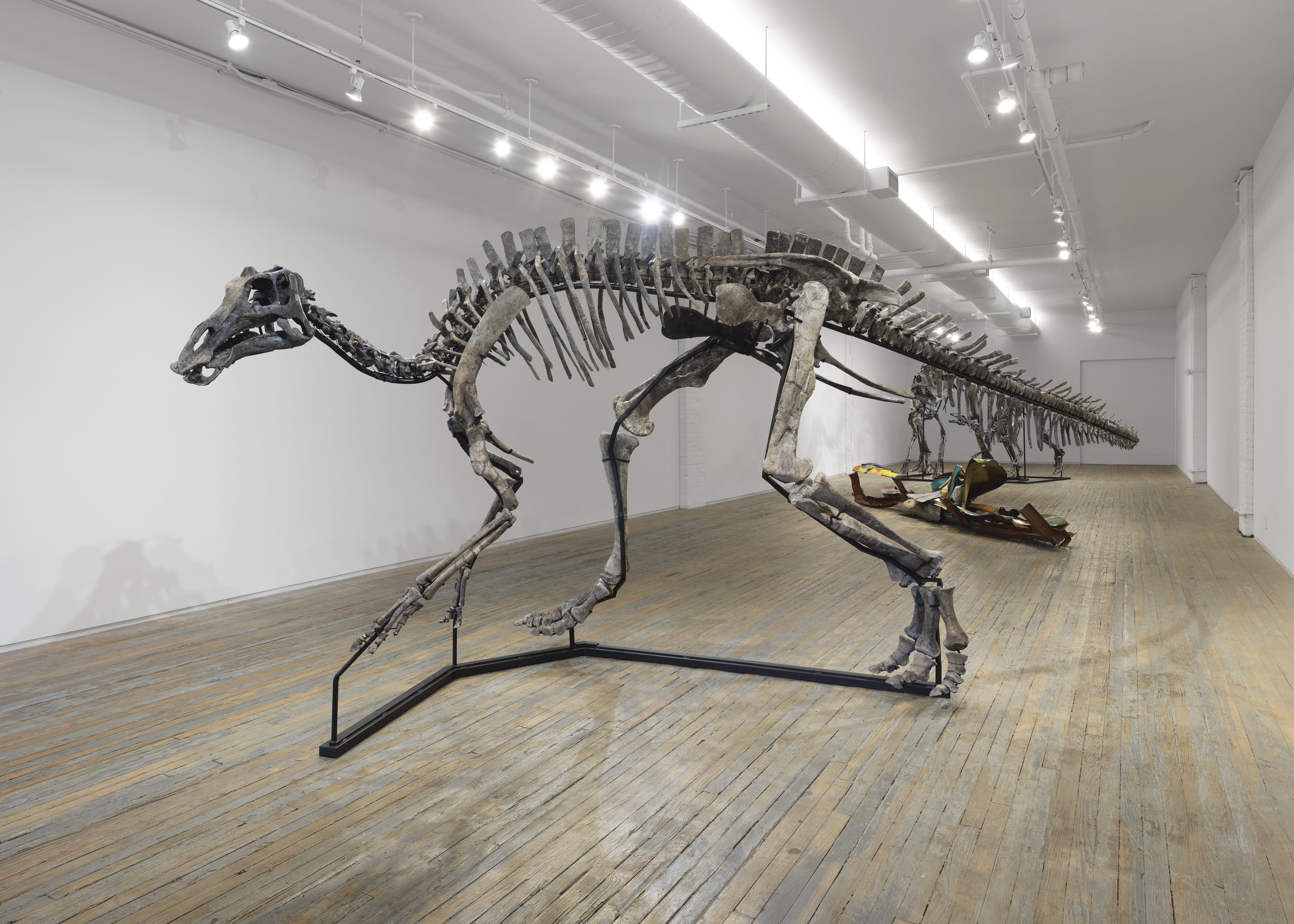
Earlier this summer at Amanita Gallery on the Bowery, three dinosaur skeletons shared the room with a John Chamberlain sculpture.
The pairing was strange and compelling. The dinosaurs are Maiasaura, more than 70 million years old. What we encountered were their structures: bones that have survived while everything that once surrounded them has disappeared.
We know what a car looks like. We spend enormous amounts of our lives inside cars, surrounded by their metal bodies, rarely considering what those bodies might look like collapsed, compressed, folded, or torn apart.
Chamberlain takes that familiar material and makes it unfamiliar. Automobile parts are crushed, bent, disassembled, and reassembled until color, composition, volume, and form take over. There is something arresting about recognizing the source material while seeing it in a condition we would hope never to encounter in life.
The dinosaur skeletons carry a different history, and they too ask us to look at what remains after the recognizable whole is gone.
There is also a growing market for these remains. In 2020, the Tyrannosaurus rex known as Stan sold for $31.8 million. In 2024, Apex, a Stegosaurus, sold for $44.6 million. Last month, another T. rex, Gus, sold for $50.13 million, setting a new auction record for a dinosaur.
Standing among the skeletons and Chamberlain’s twisted metal, I looked closely at structure. Ribs, joints, steel, curves, weight, balance. Materials separated from their original function can become something entirely different.
We know the material of Chamberlain’s sculpture. We know what it was made to do. And then he gives us another way to see it. The entire show felt eerie and unsettling, somehow prescient, like our summer weather, and not in a good way.