One of the things I loved most about Costume Art, the current exhibition at The Metropolitan Museum of Art, was the delight of recognizing a form or a pattern in one object and then finding it again in another. A Cycladic marble female figure from 4500–4000 BCE appears again in the outline embroidered into a contemporary garment. Thousands of years collapse in the distance between the two objects.
A red and white work by Yayoi Kusama filled with dots is placed beside a red and white polka-dot coat. The relationship goes beyond the shared red and white palette. The repetition of the dots changes the surface of both the painting and the coat, making it difficult to see pattern as belonging exclusively to either art or fashion. You look back and forth and the relationship is immediate. It is also fun. Looking becomes a kind of visual game, and recognition becomes part of the pleasure.
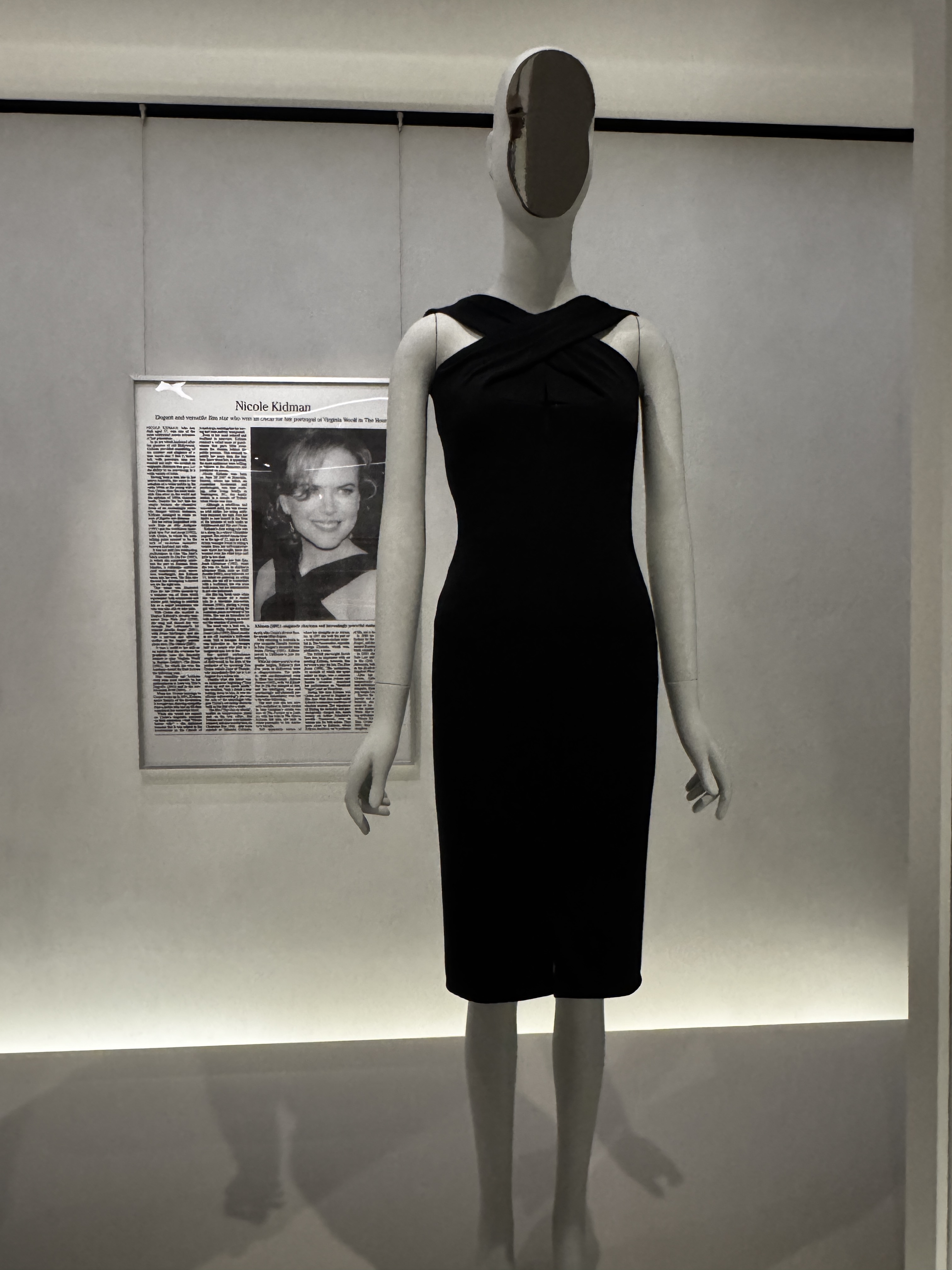
The Nicole Kidman pairing introduces humor. Adam McEwen’s work imagines her obituary, with a photograph of Kidman wearing a black dress. Next to it is the dress itself, on a mannequin. The image becomes an object, the absent body becomes a mannequin, and something potentially morbid is also incredibly funny.
Nicole Kidman recently appeared in another art context, in a video created by Sotheby’s to promote the sale of a Brancusi sculpture. She dances around the sculpture, moving with and around its form. The video circulated widely, entering popular culture in a way the sculpture itself rarely could. And suddenly there is another connection to notice: Kidman in McEwen’s artwork, the dress she wore in the photograph standing nearby, and Kidman dancing around a Brancusi years later.
Museums have historically separated objects into categories and departments, and art history has done the same. Painting, sculpture, fashion, decorative arts, ancient art, contemporary art. Those classifications help us understand things, and they can also determine how we see them. Costume Art allows objects that would ordinarily be separated by centuries, materials, purpose, and museum departments to exist together.
A sculpture made more than six thousand years ago can suddenly have a relationship with a dress made now. Kusama can become something you wear. Nicole Kidman can move from an Adam McEwen artwork into a dress on a mannequin and then dance around a Brancusi.
What else becomes connected when we pay attention with a wider lens?