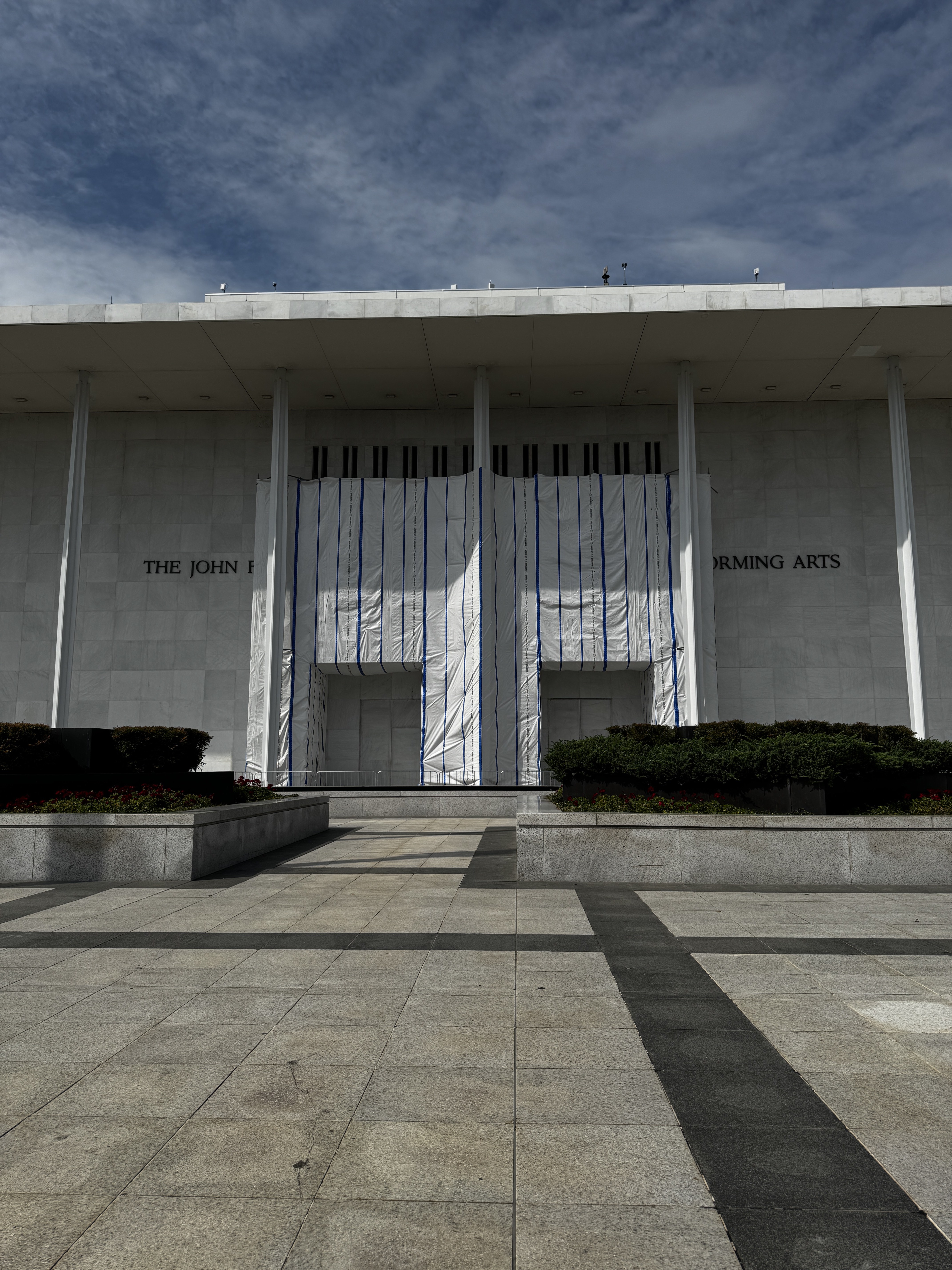
This week I went to the Kennedy Center specifically to look at the building and to think about and chronicle its weight and meaning to America. It is currently surrounded by fencing and closed to the public, and standing outside I observed what we actually preserve when we preserve architecture and what we don’t when we don’t.
The Kennedy Center is more than a building, a performing arts institution, and a memorial to John F. Kennedy. It is iconic and filled with meaning. For more than fifty years people, including myself and my family, have gone there to hear music, see dance and theater, attend the Honors, walk through its enormous halls, and look out across the Potomac. All of those experiences accumulate. A building becomes a repository for what happened there as much as for the materials from which it was made.
And architecture can become an icon in ways that have very little to do with beauty or taste. We can recognize shape. We can associate a structure with a person, an institution, a city, or a moment in history. And eventually some buildings become part of our collective visual memory.
Right now, the Kennedy Center makes those questions particularly visible. Its future, its name, the art surrounding it, and the physical building itself have all become subjects of public debate. The Kennedy Center and what it represents are being actively reconsidered.
Preservation asks us to decide what we carry forward. Sometimes that is extraordinary architecture. Sometimes it is a monument. Sometimes it is the history that happened inside a place. And sometimes the value is the meaning that generations of people have attached to a place.
What do we lose when a building disappears?
.jpg)
.JPG)